1. Apprentice Eligibility and Requirements
Q: What are the qualifications to become an apprentice?
A: Apprentice qualifications are as follows:
Apprentice I – The applicant is new to the field of Early Childhood Education and does not currently have a Child Development Associate (CDA) credential or relevant educational experience. They are a new employee at a participating employer site and have been cleared to work in a licensed program.
Apprentice II – The applicant is a current entry-level Early Childhood Education professional interested in upskilling by earning a Child Development Associate (CDA) credential; and the applicant is employed at a participating employer site.
The minimum qualifications are:
-
Applicant must be at least 18 years of age;
-
Applicant must have a high school diploma or GED; and
-
Applicant must be employed full-time by a participating employer site in an infant and/or toddler classroom.
Newly hired candidates must successfully complete a minimum 90-day probationary period and complete all required NJ Office of Licensing (OOL) and Childcare Development Block Grant (CCDBG) training requirements prior to approval.
Q: Can a teacher who has been employed by the company for some years be eligible to be an apprentice?
A: If the teacher meets the eligibility criteria for apprentices and can benefit from participating in the apprenticeship (e.g., earning the CDA infant-toddler credential, structured on-the-job training in an infant-toddler classroom, etc.), then yes.
Q: Can a staff member already working in my program be a part of this program?
A: Yes, there are two types of apprentices which were reviewed in the interest meeting.
Q: If the teacher is a “lead” at this time but does not have a CDA or degree (highest level is high school) can they be considered for the apprenticeship program?
A: No, they would not meet the minimum qualifications for the Mentor role.
Q: Can the apprentice already have a CDA?
A: Yes. They can have an Infant Toddler CDA. The apprentice will work closely with PCG/NJ Workforce Registry to help determine how required Technical Instruction credit will be applied.
Q: Can an apprentice that we recommend be someone who has already started their CDA or do they have to be someone who starts and ends while in the program?
A: It is possible so long as they are working toward their infant toddler CDA.
Q: What if a staff person is currently working on their CDA but for preschool, can they be in the apprentice program?
A: Not at this time. Apprentices must be enrolled in the infant/toddler CDA course.
Q: Can you use this program for staff currently enrolled in a CDA program?
A: Yes, however, the staff member would need to be enrolled in the infant-toddler CDA program. Our team will work with your apprentice to apply any completed CDA coursework and credits, as allowable, toward the apprenticeship accordingly.
Q: Can the apprentice work with various age groups?
A: Apprentices must be working full time in an infant and/or toddler classroom serving children between 0-2.5.
Q: How many hours does the employee have to work weekly in order to be considered full-time? Does it have to be 40 hours or is 30 hours acceptable?
A: The program does not specify a minimum number of weekly hours. The requirement is that apprentices complete a total of 2,000 on the job training hours, which we anticipate taking approximately 12-18 months on average. An apprentice working fewer than 40 hours per week would still meet the requirement, it would simply take longer to accumulate the full 2,000 hours.
Q: Can a director take the CDA and be the apprentice?
A: No.
2. Apprentice Recruitment & Hiring
Q: Is it our responsibility to identify or find an apprentice?
A: Yes, it is the responsibility of the Employer to identify and hire the apprentice candidate(s).
Awarded employer sites that need assistance with recruitment/hiring will be supported by PCG/NJ Workforce Registry and will be connected to a liaison at your local One-Stop Career Center to receive referrals for individuals interested in pursuing a career in early childhood education with an emphasis in Infant Toddler care.
Q: If we don’t have any possible CDA candidates for the program, is there a pool of interested candidates we can contact?
A: There is not a pool of candidates. For the approved employer programs, PCG will work closely with you to help you identify candidates. You will also be connected with your local One-Stop Career Center liaison to help you identify individuals who are interested in starting a new career path.
Q: We have had difficulty bringing on new staff, are there any courses for referring applicants to our program?
A: Yes, we can provide resources and support when programs have difficulty finding possible candidates.
Q: How do we communicate to you that we would like to receive the resources to find applicants (staff)?
A: Please contact the NJ Workforce Registry at [email protected].
Q: Will we have time to identify an apprentice if we are applying for an Apprentice I slot?
A: Yes, programs will have 90 days from notice of award acceptance to identify an apprentice candidate.
3. CDA & Scholarship Information
Q: Where are the CDA courses taught/by which agency?
A: There are many CDA Training agencies, providers, and institutes within NJ. We will provide a list of training agencies that currently have agreements in place with the NJ Workforce Registry and accept the NJ ECE scholarship. Apprentices must select an agency that currently has an active agreement with the NJ Workforce Registry. Most of our current agencies offer virtual classes, and they are all over the state, including community colleges.
Q: What CDA Credential can an apprentice enroll in?
A: Apprentices must pursue an Infant Toddler Child-Development Associate (CDA) Credential.
Q: How do apprentices qualify for the scholarship?
A: Apprentices will select a CDA infant/toddler training program from an approved list we provide. These providers have active agreements with the NJWorkforce Registry and accept the NJ ECE Scholarships. The apprentice will complete the CDA Training Scholarship application through NJCCIS. Our team will guide both employers and apprentices through the process at that time.
Q: Will this be a scholarship via NJCCIS again? Also, if they already applied for a scholarship, will they be able to do it again (e.g., if they started a CDA but never finished it)?
A: Yes, apprentices will be required to apply for the NJ Scholarship to support the CDA expenses. We would need to review the individuals records to determine if the person would qualify for an additional scholarship if they previously did not complete the program.
Q: What is the typical cost of the CDA course through an approved program?
A: The typical cost of a CDA program is $1500.00. The assessment (testing) is $525.00. Both are paid through the scholarship program on NJCCIS.
Q: Can you provide a work description of the apprenticeship for us to post?
A: We do not have a specific job description; you can use your standard ECE teacher job description as a base and tailor it to fit the Apprentice role. The minimum qualifications are:
-
Applicant must be at least 18 years of age;
-
Applicant must have a high school diploma or GED; and
-
Applicant must be employed full-time by a participating employer site in an infant and/or toddler classroom.
Newly hired candidates must successfully complete a minimum 90-day probationary period and complete all required NJ Office of Licensing (OOL) and Childcare Development Block Grant (CCDBG) training requirements prior to approval.
4. Mentor Requirements & Role
Q: What are the requirements to become a mentor?
A: The Mentor education and experience minimum requirements are as follows. The Mentor must:
-
Possess an Associates or Bachelor of Arts in Early Childhood Education, Child Development, Human Services, or related field from an accredited post-secondary institution; and
-
Have a minimum of 2 years’ experience in an infant/toddler classroom.
-OR-
-
Possess a valid and current Child Development Associate (CDA); CCP; New Jersey Infant/Toddler Credential; New Jersey Family Development Credential; US Department of Labor Child Development Specialist; or NJ Office of Licensing (OOL) Group Teacher approval; and
-
Have a minimum of 3 years’ experience in an infant/toddler classroom.
Q: Can a director be a mentor?
A: Yes, if they meet the minimum qualification for the role. Director’s intending to be a mentor must consider that a significant amount of their time will be needed in the classroom to observe, guide, model, and provide constructive feedback to the apprentice. Directors must consider how this can be done while also staying in compliance with any OOL regulations of the Director position. All mentors, regardless of position at their center, are required to participate in 40 hours of foundational mentor training and be in compliance with OOL regulations. It is a 1:1 ratio. So, a director may only mentor one apprentice.
Q: Can 1 Mentor- mentor up to 3 apprentices?
A: No, each apprentice must have their own mentor. The Mentor to apprentice ratio is 1:1.
Q: Does the mentor need to work in the same classroom as the apprentice or can the mentor hold the role of Head Teacher within the center?
A: Ideally, the Mentor would work in the classroom alongside the apprentice each day, however, we are aware that this is not always possible. Any employee meeting the minimum mentor qualifications may be identified as the Mentor, but those intending to be a Mentor must consider that a significant amount of their time will be needed in the classroom to observe, guide, model, and provide constructive feedback to the apprentice. Programs must consider how this can be done while also staying in compliance with any OOL regulations. All mentors, regardless of position at their center, are required to participate in approximately 40 hours of foundational mentor training to prepare for the role.
Q: Can a mentor have a BA in History Education K-12?
A: Yes, so long as they have had a minimum of 2 years’ experience working in an infant and toddler classroom as a teacher.
Q: Does an individual who has their CDA in Preschool qualify as the Mentor?
A: Yes, so long as meet the experience requirement.
Q: How many hours of coaching is required for the mentor?
A: All mentors are required to complete approximately 40 hours of foundational mentor training to prepare for the role. This training is provided through our program partner, the New Jersey Early Childhood Leadership Institute (ECLI), and includes group learning sessions and monthly coaching sessions throughout the program.
Q: If they are a mentor, we would also need to replace them in the classroom if they are currently employed- is that correct?
A: Ideally, both apprentice and mentor would be working together in the classroom. If not, grant funds may be utilized for substitute support during mentor/apprentice training.
Q: Our program is part of the apprenticeship program now. Can we use the same mentor for the second pilot program?
Yes, so long as the mentor continues to meet the eligibility requirements to serve as a mentor and remains in good standing with the employer.
5. Compensation, Wages & Use of Funds
Q: What pay rate do we have to provide the apprentice?
A: At the time of hire, the apprentice must receive minimum wage or higher with the requirement that the apprentice(s) receive a 3% increase upon completion of the program. All employer sites will be required to provide a salary scale.
Q: What is the starting salary expected to be for the apprentice?
A: There is not a minimum salary requirement (beyond minimum wage standards). The employer sets the apprentice’s wage according to the organization’s established HR policies and procedures as you would with any other employee. The only requirement is that apprentices will earn a 3% wage increase upon program completion.
Q: The payment breakdown to apprentice and mentor is on top of what we pay them per hour or salary biweekly?
A: Funding provided in this grant designated for the apprentice may be used to supplement the apprentice’s current salary and/or be used to support the minimum 3% wage increase upon completion of the program requirements. If funds are used solely to supplement the apprentice’s regular salary throughout the grant, the employer is still responsible for providing a minimum 3% salary increase upon completion of program requirements.
Q: Is there a state-mandated salary increase for the mentor?
A: No. The minimum 3% wage increase upon program completion applies to the apprentice only, not the mentor. Mentor compensation is an allowable use of grant funds at the employer’s discretion, but there is no mandated salary increase specifically tied to the mentor role.
Q: Can all funds be used for salary?
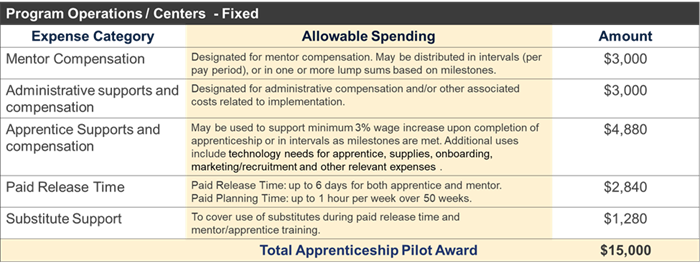
A: Grant funds are intended to support the costs associated with the apprenticeship program, including wages, according to the chart below:
Q: Can you also use the grant toward increasing the mentor’s wage for the time period that they are mentoring?
A: Yes, mentor compensation is an allowable expense capped at $3,000.
Q: Does the $15,000 grant include payroll taxes?
A: Payroll taxes may be accounted for under any expense category intended for “compensation.” Please consult with a tax professional for tax related questions.
Q: If my school has a union and set salaries for assistants and teachers, does this pose a potential conflict for the pay structure of the apprenticeship?
A: Having a union and a set salary schedule does not automatically create a conflict with apprenticeship participation, as employers continue to set wages in accordance with their collective bargaining agreement (CBA). Our standards require a minimum 3% wage increase, which in unionized settings may be met through existing step increases, education differentials, or promotional movement outlined in the CBA. We encourage employers to review their agreement and coordinate with union leadership to ensure apprenticeship completion is recognized within the established wage structure.
6. Program Requirements & Expectations
Q: Is there a timeline for when the 2,000 hours of On-the-Job Training (OJT) needs to be completed by the apprentice?
A: The timeline for completion is based on how many hours the apprentice works per week. On average, we expect approximately 12-18 months for timeline completion.
Q: Can apprentices start at any point during the year?
A: You must identify your apprentices within 90 days of your grant award.
7. Program Changes, Retention & Completion
Q: What happens if the apprentice leaves the program?
A: The Sponsor Organization, PCG, will work with the awarded employer site to help identify another apprentice candidate. If the employer is unable to identify or support a new apprentice, the employer will be removed from the program and unspent funds must be returned to DFD. The apprentice candidate would be expected to continue with their obligations of completing their education program under the NJ Scholarship Program if they are able to do so.
Q: Is retention of funds contingent on the apprentice completing the CDA program?
A: If an apprentice leaves the program, we will work with the employer to identify a replacement candidate. If the employer is unable to identify or support the new apprentice, the employer will be removed from the program and unspent funds must be returned to DFD.
Q: What happens if an employee in the program leaves before the 12 months are completed due to a move or something else?
A: It is looked at on a case-by-case basis. Depending on when the person leaves, you may be able to enroll a new apprentice.
Q: Once they complete the apprenticeship, do the employees need to stay with us? Is there a contract for them?
A: It is expected that apprentices will remain employed with your organization following the completion of the apprenticeship program. Apprentices are employees of the organization and are expected to be retained as such so long as their employment is in good standing.
Q: After the program ends, can we fire the apprentice for long term?
A: The apprentice is your employee and is expected to remain your employee after the apprenticeship ends. However, if there are performance or disciplinary issues, you would implement the same disciplinary measures (following company policies and procedures) as you would any other employee.
8. Language & Accessibility
Q: Are apprentices required to be fluent in English to attend monthly meetings?
A: No. Our team will work with you to determine the best means of communication for apprentices whose native language is not in English.
Q: Are ECLI coaching and training supports available in Spanish?
A: Yes. We recognize the importance of language access and will work on an individual basis to provide appropriate accommodations for Spanish-speaking apprentices and/or mentors, as needed.
9. Training & Administrative Details
Q: Will the Interest Webinar presentation slides be shared with us?
A: You can download the presentation here Apprenticeship - Child Care In New Jersey
Q: Will a recording of the Interest Webinar be shared?
A: No, all information presented can be acquired by reviewing the presentation slides and this FAQ.
.png?width=400&height=400 "Activate-Today-English-(2).png")